

This Q&A Interview is best experienced on Substack, where the full piece can be read in its entirety. If you’re reading from your inbox, the message may be shortened. Feel free to click through to read the full article inside The Nourished Sensitive Magazine.
In this conversation:
The Five Pillars for Raising an Embodied Independent Eater
The Six-Step Process for Complex Feeding Dilemmas
It’s not whether you restrict, but how – setting healthy limits
When feeding your kid gets messy (and the research doesn’t help)
Running your family restaurant – a metaphor for mealtime
For picky or sensitive kids who need a different approach
When it’s more than just “picky eating”
What courage to "feed them well actually means
If you’re struggling to nourish your picky, sensitive or neurodivergent child, and help them nourish wisely without your constant supervision, this is the conversation you need.
Listen above, or read the full Q&A conversation below.
Interview recorded August 7th 2026.
When feeding your kid gets…messy

When you became a parent, you probably thought feeding your child would be the easy part.
You swore you’d never bribe your kid with dessert, never make a separate meal because it was easier than a standoff, never hear yourself say, “just try it”, in a voice that wasn’t yours.
Or maybe your kids ate great for years until your oldest child came home one day and said, “My friend says bread makes you fat,” and you froze. Now what?
Between picky eating, confusing nutrition headlines, algorithms and media literacy, and the fear of saying the wrong thing about food or bodies, it’s hard to feel confident as a parent.
Where do we turn when things get messy like this?
Our guest today is child-feeding and nutrition expert, Jennifer Anderson, MPH — Founder of Kids Eat in Color
When Jennifer’s son showed early flags for picky eating and started to fall off his growth chart when he was just ten-months old, she felt lost about what to do, and where to find good information on the topic.

Despite her background in nutrition and public health, and an extensive library of information and research on the topic of child feeding, she discovered that even the best, most researched-backed advice wasn’t enough for her kids’ specific feeding issues.
That experience eventually led Jennifer to create Kids Eat in Color, where she now helps millions of parents navigate the feeding issues the research doesn’t always have answers for.
“My kids did not do what the book said they would when I tried it, and I was left with this feeling of I must have done it wrong. The reality was, no book was written for my child’s unique needs.”
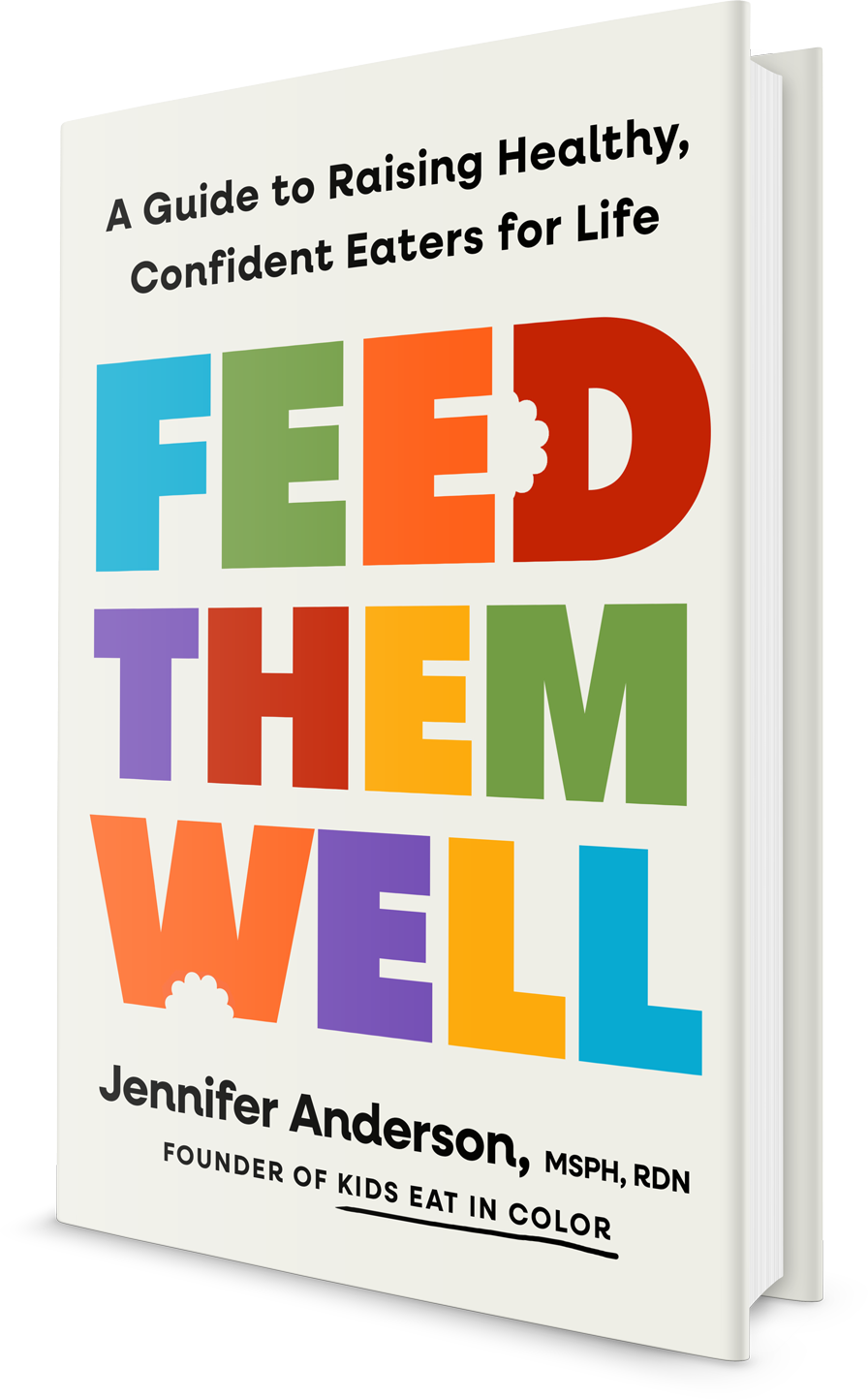
Feed Them Well: A Guide to Raising Healthy, Confident Eaters for Life – Available for Pre-Order Now (before Sept 8th)
In Jennifer’s new book — Feed Them Well: A Guide to Raising Healthy, Confident Eaters for Life — she takes overwhelmed parents of picky eaters, through what she’s learned and gathered from her own experiences as a parent, and as a dietitian specializing in this area.
Feed Them Well offers the essential guidance to raising an independent, fully embodied eater and feeding your child from baby’s first foods through the teen years – offering the exact words, scripts, and frameworks to solve your kids’ unique eating challenges.
It’s available for pre-order before its release on September 8th.
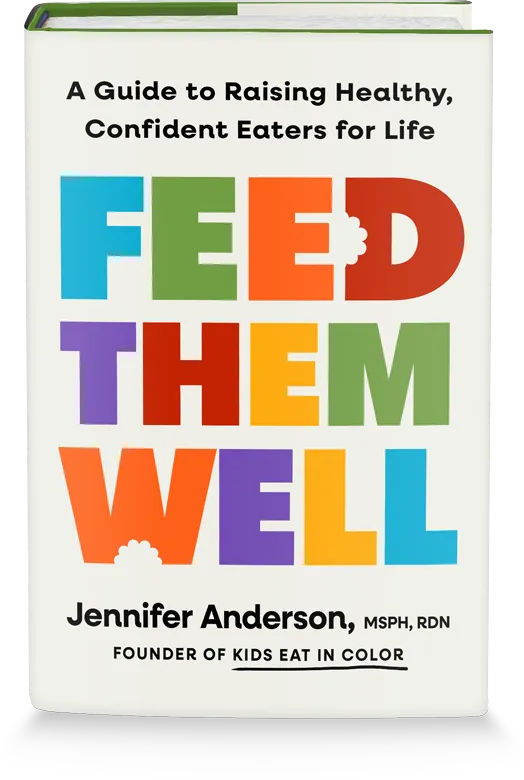
For a complete overview of Jennifer’s Five Pillars of Eating for Raising Eaters with Embodied Independence + Six Step Decision Making Framework for Feeding Dilemmas, pre-order Jennifer’s new book Feed Them Well before September 8th.
You’ll Receive These Free Essential Pre-Order Bonuses:
How to Talk About Fruits & Veggies Printables
How to Talk About Weight & Health Conversation Guide
Bedtime Snack Chart
Live Video Q&A with Jennifer and Grandma: the grandparent conversation every family navigates. (post-event recording link from August 12th)
Featured Q&A Interview – with Jennifer Anderson of Kids Eat in Color
What follows is an edited version of my conversation with Jennifer. We talked about what happens when feeding advice meets the complexity of real children: picky eating, restriction, independence, family dynamics, and how parents can make thoughtful decisions when there isn’t one perfect answer to their particular feeding challenge.
Listen to the full conversation above, or read the edited Q&A interview below.
Throughout the interview, you’ll find callouts highlighting Jennifer’s key frameworks and principles, along with real-life feeding scenarios that show what those ideas can look like when applied to the messy, nuanced decisions families actually face.
This Q&A interview has been edited for length and clarity.

Most parenting self-help books end at the instruction. Your book explores what to do when good advice and even research fails. Why write it that way?
There are so many parenting books out there that tell you what to do, but not the how. I’ve read plenty of them. They’re like: if you do this, your kid will do this, and then it’s all fixed.
But what happens when it doesn’t work?
You’re going to encounter a feeding situation, or a body situation with your child, where it’s complicated and not cut and dry.
Most books won’t tackle that.
Research is also kind of weak on the topic of child feeding, and often hasn’t observed the needs of the neurodivergent kid, the minority kid, the sensitive kid, or the kid who’s just a little bit different from the rest.
I wasn’t going to leave all the other parents hanging when I could give them the tools and frameworks for helping their kids in a way that’s more tailored to their needs.
You get noticeably fired up about the phrase “the research says” when it comes to advice often given on child feeding. What’s wrong with it?
It’s just not how research works.
Here’s how a study works:
A hundred kids hear a book about the bunny who eats carrots, and then they’re given carrots. A hundred other kids don’t hear the book, and they’re also given carrots.
A really dramatic result would be seventy kids ate more carrots, twenty didn’t change, ten ate fewer. In reality it’s more like forty percent ate more. And then people say, oh my gosh, stories help kids eat more carrots!
Okay, but don’t forget a good thirty percent did not.
Good research never shows that everyone had a result from the intervention. So if somebody is throwing around “the research” without acknowledging this nuance, I guarantee you they’re not representing it accurately.
The problem is, there also isn’t a lot of really reliable research in the child feeding bucket, so many parents are guessing at what works, and feeling frustrated when it doesn’t help.
“Research is a bucket. Every study goes into that bucket. When we want to know what the research says, we have to look in the bucket, not at the individual studies— to see the consensus that built over time.”
That’s a lot to ask of a parent scrolling at ten at night when their kid won’t eat. How do you suggest parents approach this?
I’m not expecting parents to put in the same time I did to learn how to read a study, but I do want you to have a healthy skepticism, and to notice when someone is using research irresponsibly.
Anybody can use the words research and evidence. Anybody can pull out one or two studies that say literally anything they want them to say.
What you hear in the media, from your friend, or from a research study doesn’t necessarily reflect the totality of the evidence, nor does it work for every child. Parents have to learn to be discerning consumers of that information, and rely on their own judgement.
You organized the everyday half of the book around what you call the Five Pillars of Eating with Embodied Independence. What are they, and why those five?
Feeding kids is such a big topic.
There’s so much in there, and if I hand you all of it at once, you’d probably be overwhelmed and would want to put the book down.
Instead, the book breaks all of it down into five foundational pillars of feeding your kid well that, in my experience, actually have the most impact over time.
Every one of them is building toward the same thing, the same goal.
To raise your kid as an embodied independent eater – a kid who’s in their body, listens and responds to it, and knows how to take care of it without your constant supervision.
The pillars are the everyday essential conditions that make that possible.
THE FIVE PILLARS · a framework for raising embodied independent eaters.
The Five Pillars for Raising an Embodied Independent Eater are less a set of rules than a set of orientations to approaching food with your child.
Summarized here in brief; the book gives each one a chapter.

Pillar 1 – Feeding with curiosity
An orientation of observing your child’s needs as your primary source of information on how to approach feeding, and being curious about what you find.
Pillar 2 – Eating with embodied independence
An orientation of teaching your child how to live inside and listen to their body while also taking care of it with clear limits and expectations around food.
Pillar 3 – Eating together
An orientation of sharing meals as structure, comfort, familiarity, and modeling around food and eating, with room to adapt when togetherness isn’t possible.
Pillar 4 – Eating without judgment
An orientation of modeling healthy boundaries around certain food, such as hyper-palatable snacks, held without guilt, shame, or fear stacked on top of them.
Pillar 5 – Eating what nourishes us
An orientation of prioritizing nutrition based on your child’s specific needs so that they get the essential nourishment they need for living, growing, and thriving.
The Five Pillars in Action: Guide Your Sensitive Eater to Eat with Embodied Independence
Your seven-year-old is autistic and eats six foods. Plain pasta, crackers, apple slices with the skin off, one brand of yogurt, cheddar cut into squares, chicken nuggets from one restaurant. She gags at the smell of anything roasting. She cried last week because her pasta touched the broccoli. She’s not being difficult — she’s a child whose sensory system runs loud, and dinner is the loudest room in the house.

Pillar 1 – Feeding with curiosity
You stop trying to solve it and start collecting information. Not why won’t she eat this, but what is already true about what she does eat. Crunchy and smooth, never mushy or mixed. Cool more often than hot, because heat carries smell. Apple with the skin off — texture, not flavor. The six foods stop looking like refusals and start looking like rules her body is already following.
Pillar 2 – Eating with embodied independence
You hand that back to her in words. Empty and growly is hunger. Tight and fluttery is nerves. You name textures like colors so she has vocabulary for what her body reports. One night she says her tummy feels “spiky,” and you help her sort it. You decide what’s served and when; she decides how much. A kid who can tell hunger from anxiety comes to the table for the right reason.
Pillar 3 – Eating together
With language for her body and a limit she can count on, the table becomes survivable. You adapt so it stays that way: broccoli in its own bowl, window cracked, food plated after it cools, her seat farthest from the oven. The family talks about the roasted vegetables and everyone tries a bite.
Pillar 4 – Eating without judgment
Togetherness only stays safe if nothing on the table carries a charge. Her safe food is there every night as a given, not a reward. Nobody earns dessert. The kitchen closes after dinner the way bedtime comes — structure, not judgement.
Pillar 5 – Eating what nourishes us
Now your effort goes somewhere specific. Protect the six and fortify what works. When you add, add along the lines Pillar 1 gave you: crunchy, cool, unmixed, single-ingredient. One addition at a time. Some weeks the win is a new protein. Some weeks it’s that she keeps all six.
Six months later…
She eats nine foods now. The pasta is still plain. But there’s a second yogurt, a cracker with seeds in it, and — some nights, not all — a few florets of broccoli, cooled, in their own bowl, that she eats with her fingers and calls “the trees.” The kitchen still smells like roasting some nights, and she still doesn’t love it. The difference is that she’ll say so. That smell is too much for me, can I sit at the end? Then she sits down, at the end, and eats her dinner with the rest of the family.
She’s not a different kid. Her sensory system runs exactly as loud as it did. Dinner is still the loudest room in the house. It’s just no longer the hardest one. What changed is that she knows what it’s telling her, she has the words to pass it along, and she’s stopped having to defend herself at her own table.
She’s becoming an embodied independent eater, and the table – a happy place for family connection and nourishment.
It’s not whether you restrict food, but how.
Food restriction is an important topic for many parents. What does the research say about that? Is it bad to limit what kids eat?
In feeding, restriction might mean a parent limits a child’s access to a particular food — usually sweets, snacks, or whatever’s being eaten in worrying quantities.
For example, two cookies instead of six. Dessert on some nights and not others.
You may have heard that if you restrict how many cookies your kid eats, you’ll give them a bad relationship with food, maybe even an eating disorder.
That is not supported by the research at all.
You changed your own position on restriction while writing Feed Them Well. That’s not a small thing to put in print, and I know you’ve faced some backlash.
It took a lot of soul searching.
I wanted to give parents better answers to this question, and what I found was that restriction is the most inaccurately reported research on any topic I’ve ever seen in nutrition.
After that, I was like, "oh my gosh, have I told parents the wrong thing over the years?
The answer is no — but now I can give parents more permission.
It was a chance to model what it looks like to change your perspective when you get new information.
So, how do we approach restriction with kids?
You can absolutely restrict a child in a way that creates enormous guilt and shame.
That’s what we want to avoid.
Say your kid is eating a whole box of cookies in one sitting and you think, this can’t be good for anybody.
Rather than getting wrapped up in whether you’re allowed to set a limit here, ask yourself a different question: how do I teach my child to have healthy food boundaries without shame?
There’s something I call adding on qualifications.
Only two cookies, because…
you don’t know how to listen to your body.
Only two cookies, because…
if you eat more it’ll make you gain weight.
Only two cookies, because…
I can’t trust you.
There’s an implied layer of guilt, shame and fear on top of the restricted cookies that doesn’t need to be there, and could create harm to your child’s relationship with food.
To reduce that risk, you can simply say: everybody’s having two cookies today.
It sets a clear boundary without judgment, and teaches your kid the limits.
In both cases you’re restricting.
In one you’re adding shame, fear, or guilt that can cause a kid to develop uncertainty around food. In the other you’re setting a boundary and holding it, which is your job.
That’s the how.
“The question isn’t, are you restricting? The question is how. How are you helping your child take care of their body? How are you talking about food with them?”
You run the family restaurant

Walk me through your family restaurant metaphor. I love it.
Picture your kitchen as a small restaurant. You’re the owner and the chef. You write the menu, you set the hours, you decide what comes out and when.
Your kids are the patrons.
Patrons are welcome to have opinions, and a good restaurant listens to them, but patrons do not run the kitchen.
That doesn’t mean you never ask their opinion or offer choices. But when you’re in charge, you can model what taking care of yourself and eating well actually looks like.
By putting balanced meals on the table, letting your kids get hungry between meals and snacks, and setting non-judgmental limits, your family restaurant teaches them to eat well.
“The parent builds the structure, and the structure is what makes the whole thing feel safe and predictable enough for a kid to relax into.”
That’s what leads to more of what you call “embodied independence”. Break the term down — it’s carrying a lot.
I had to go with something wonky here, because the English language let me down.
The first word, ‘embodiment’, in essence, means really living in, and experiencing the world through your body. The independence side is all about gaining reasoning skills, wisdom and knowledge to decide — this is how I eat well and take good care of my body.
Why do we need to teach both embodiment and independence?
Because with embodiment alone, we can’t fight diet culture, or the influences of food marketing and engineering.
Hyperpalatable foods, the ones with added fat and sugar and salt, were designed to mix up our internal signals. They were designed and engineered and tested to be that way. They are also marketed to look appealing.
So if we’re just listening to our bodies, we may fall prey to the food industry.
We also don’t want our kids getting pulled into diet culture, and the internalized weight bias and negative body image that comes with it, any more than they have to.
But algorithms can be tricky.
Say your child looks up how to make a smoothie.
The next one is how to make a healthy smoothie. Then how to lose weight using smoothies. Then how to help yourself not be hungry, or how to get GLP-1 medications from a friend. A kid can end up in pro-eating disorder content without ever having looked for it.
I don’t like to scare parents, but this stuff is real.
We do have to be really engaged in what our kids are seeing online and talking to them, while also raising them to be embodied, independent eaters.
For picky or sensitive kids who need a different approach
Many of the people reading this are sensitive or neurodivergent eaters themselves, raising kids who are too. Where does embodied eating fit for them?
It’s our job as parents to reduce access and increase the barriers to some of the things that make kids lose touch with their internal fullness cues — especially neurodivergent kids.
Often those kids have a harder time with interoception (the ability to feel and name what’s happening in the body). Often they have higher reward responses to hyperpalatable foods.
Eating in an embodied way may not come automatically to neurodivergent kids, but I’m always asking: how can we still make sure these kids can eat in a way that supports their unique body and wiring?
I’ve heard it framed that neurodivergent folks just can’t hear or access those interoceptive signals. What are your thoughts?
I can’t buy into that.
Will there be people who never learn to listen to their body and become embodied eaters? Sure. But families in our programs report it constantly: kids with ARFID, kids diagnosed with autism, kids who are just different with no diagnosis at all.
They can learn it.
They might learn it differently, and they might never learn interoceptive body awareness in the automatic way more typical kids do. But our brains are plastic, and just because your kid is neurodivergent doesn’t mean their brain can’t learn a new skill.
One of my pet peeves as a person is people saying “I can’t.” My kids make fun of me because I get on this soapbox all the time with— it’s not I can’t, it’s how can I?
We need to think about accommodations.
For sensitive, or differently wired kids, that’s also true with eating.
What does explicit teaching of embodiment look like at the table for neurodivergent kids?
It’s naming the inside out loud.
How do you feel? What does it feel like to you? What word would you use?
A kid who’s neurotypical might just pick that up.
A kid who has trouble with interoception is not necessarily going to.
So you say: I have all these squiggles in my tummy — that helps me understand I’m a little bit worried. You’re just describing how you feel over time, and inviting your child in to their body, whether they engage right now or not.
The family restaurant metaphors does a lot of work here too.
If we’re jumping in with a snack every moment, boredom and sadness and hunger start to blur together, and for a kid who’s already struggling to tell them apart, that just makes it harder. Instead, we want to be consistent about when meals and snacks happen, because that lets appetite build more noticeably.
The goal is not hangry children. The goal is for kids to have an appetite, so the feeling of hunger becomes clearer to them — and then fullness becomes clearer by contrast.
It’s hard when your kids has different developmental needs and there are a lot of things you have to teach them explicitly. So maybe you work on these skills now, or maybe you work on other skills instead. Whether you get to this right now or not, it’s okay.
Just keep experimenting and find support if you need it.
What about when the food accommodation or rule a kid needs is one you’d normally never recommend?
That happens. That’s why it’s important we approach things with weight neutrality, where we’re not focused on gaining or losing weight. One of the things we do look at when it comes to trying new things with food is your child’s growth curve.
Are they still growing well?
If a kid is eating so much that they’re throwing up, or they have a bad stomachache all the time, and you’re also seeing them gain past their curve at the doctor — something’s amiss.
So you step in, again without the qualifications:
We’ve had enough for dinner, we’re all going to get up and go for a walk.
You’re teaching your kid embodied independence without judgment.
The reverse is true too.
If a child is losing weight off their curve or faltering on it, they may not be eating enough, and there may be times you actually have to say, you can’t get down until you finish your plate — which is something we as dietitians were taught to never suggest.
So much of this is just tuning into your kid, especially if they have different needs.
Don’t be afraid to break “the rule” if your kid needs you to.
When a parent is standing in the kitchen at 5pm and the best practice they’ve been given clearly isn’t working — what are they supposed to do instead?
Put the rule down. It likely wasn’t written or researched for your kid anyway. And then instead of grabbing for another rule, you need a way to think — which is what the six steps are.
THE SIX-STEP PROCESS · a decision-making method for navigating feeding dilemmas
The 6-Step Process for Feeding Dilemmas is designed to help parents navigate complex food situations without judgment or perfection.
When you find yourself facing an issue with feeding without an instruction manual, work the six steps to find your own evidence-based solution for your child’s feeding dilemma.
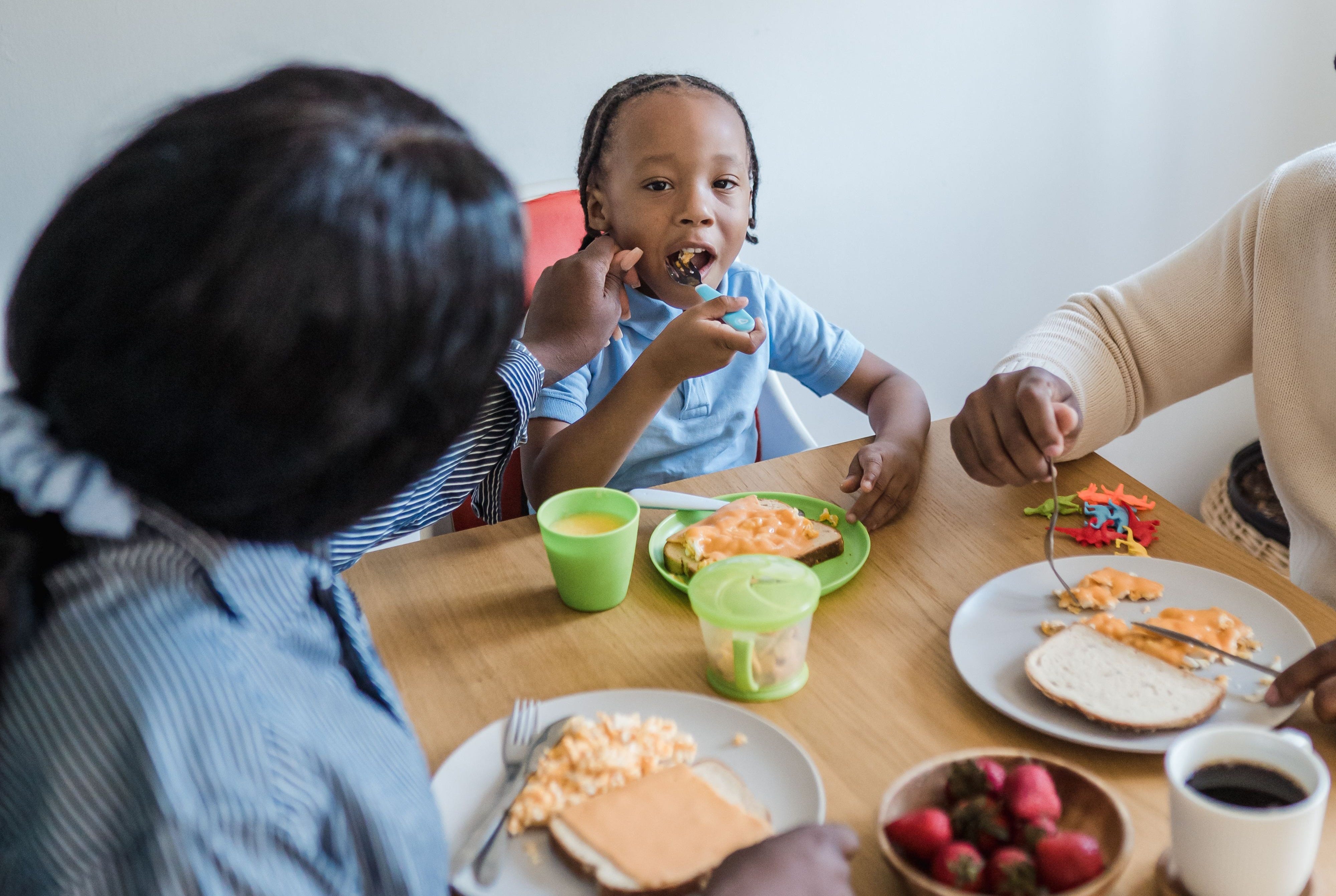
Step 1 – Separate fact from fiction
Look in the bucket; notice who’s selling you certainty. Be discerning about research.
Step 2 – Pick the priority
You can’t work on everything at once. Choose the one that matters most right now
Step 3 – Brainstorm with a twist
Generate options without filtering for what you’re supposed to do.
Step 4 – Take a risk reduction approach
Choose the experiment with the smallest downside if it doesn’t work.
Step 5 – Think like a scientist and start an experiment
Small, observable, time-limited, curious mindset.
Step 6 – Celebrate your wins as you tweak
A result you didn’t want is still information, and a result you did want is cause for celebration and continuous learning.
The Six Step Process in Action: An After School Snacking Dilemma
Your eight-year-old comes home ravenous and eats crackers steadily from 3:30 until dinner, then won’t touch the meal. If you cut the snacks off, you get a meltdown. You’ve read that restricting snacks causes kids to fixate on food, so you’ve stopped intervening — and now nobody’s eating dinner.
Step 1 – Separate fact from fiction
The claim you’re operating on might be that setting a limit will damage your child’s relationship with food. Look in the bucket: what the research actually distinguishes is how the limit is set, not whether.
Step 2 – Pick the priority
You could work on meal timing, sitting at the table, healthy snacking, and dinner all at once. Pick one. The priority is that an appetite arrives at dinner. Everything else waits, possibly for months.
Step 3 – Brainstorm with a twist.
List every option without filtering for what you’re supposed to do — including the ones that break the rules. Investigate how they’re eating at school. Move dinner to 5:00. Serve dinner components as the after-school snack. Plate the snack instead of leaving the box out. Let him eat standing up. Drop the family meal entirely for four weeks. There’s no right or wrong.
Step 4 – Take a risk reduction approach.
“No more snacks” carries real downside: hunger, meltdown, and shame stacked on top. Lower-risk version: one plated snack with protein at 3:30, eaten at the table, kitchen closed after — and dinner moved to 5:30. If it fails, he still ate a real snack and had an early dinner. Nothing lost.
Step 5 – Think like a scientist and start an experiment.
Two weeks. One thing observed: did he come to dinner and eat anything at all? Not whether he liked it, not whether he ate vegetables. Note it in your phone each night so you’re working from data instead of the memory of the worst evening.
Step 6 – Celebrate your wins as you tweak.
He ate something at dinner five nights out of ten, up from zero. That’s the win — name it. Then tweak: 3:30 was still too late, so try 3:15. The crunchy safe food stays in the snack, because that’s what makes it tolerable. Run it again.
Note: for a neurodivergent child, the tweak is usually an accommodation — a visual schedule for when the kitchen opens and closes, a timer so the transition isn’t a surprise, the safe food guaranteed at every meal, etc.
What to do when it’s more than just “picky eating”
How does a parent tell the difference between hard and clinically concerning?
If you have a very picky eater, you may be feeling uneasy. But every time you bring it up with your child’s provider they just say: let’s wait and see. Every kid is picky.
No, not every kid is picky. And, if it’s a real problem, they’re not going to outgrow it. You’ll just have lost all that time where you could have done something to help them.
With my son, I noticed the red flags at about ten months and after that, we used therapeutic feeding tools really consistently. I was able to support my son through it, and give him the right set of tools.
My son was picky, but he never became an extreme picky eater. It never affected his growth, his development, or his social functioning. Then around six, he started using the tools intentionally on his own.
There are plenty of areas in parenting where I didn’t feel like we really did it well, but this is one where I thought, oh my gosh, we did the thing! That was a win.
The distinction between ordinary pickiness and extreme pickiness mattered enough that I brought together a group of child healthcare professionals to build a screener — the PSA-Eat, which is designed to help parents identify and get help for extreme picky eating in their child, including screening for ARFID (Avoidant Restrictive Food Intake Disorder).
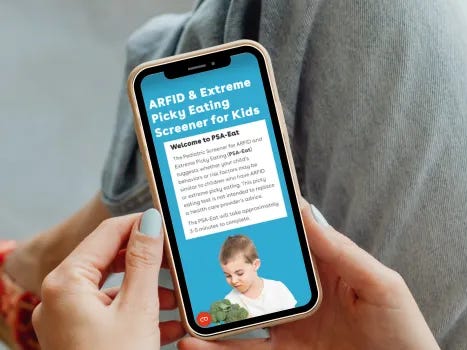
If the screener flags something, what’s next?
Two things. Print off the results — you get them by email — and send them to your child’s healthcare provider, especially if there’s weight loss involved. They need a workup, blood testing, to make sure they’re actually okay. A lot of these kids have nutrient deficiencies.
Then look into a family behavioral intervention, which is part of almost all ARFID and extreme picky eating treatment. That’s where you learn a more therapeutic parenting style.
And here’s something I’ve talked to so many professionals about that they never think about: if you’ve got a neurodivergent kid, there’s a good chance they may have a neurodivergent parent.
What programs were created for neurodivergent parents? None.
Our picky eating program is built for shorter attention spans, easier to read, broken up to make it less overwhelming.
That’s the kind of support parents of picky eaters often need.
What courage to feed them well actually costs.
In the final chapter you wrote about courage. What’s the fear it’s answering?
As parents, of course we want certainty when it comes to feeding our kids. We want that a lot. And when we go online and read something by an expert, we still have to remember that uncertainty is sometimes manufactured so we will buy their certainty.
What’s harder than finding the “right” answers — but also more accurate, and what parents really need — is the courage to pay attention to their child, figure out what approach that child needs, and experiment in their own way.
That takes courage.
Because you’re saying: yeah, I heard everybody say all those things, and research seems to back it, but that does not work for my family.
When you take that fear or uncertainty and become courageous with it, the strategies that your kid needs will become clear and you’ll grow as a parent.
Your confidence develops, because now you know how to run an experiment and how to make a decision. You know how to trust yourself as a parent, and don’t need someone to tell you what to do because you know what to do for your child.
That doesn’t mean it will always go the way you want, but the experiment was still worthwhile, even when you learn it’s not a good fit.
What would you say to the parent who’s already sure they’re failing?
Every family has a mess in some ways.
And sure, there are always things you can work on — that’s just part of being a human, part of being a parent. But you’re probably doing a lot more things right than you think you are.
Whatever the situation is, I always go in assuming the best of a family. I just know they’re doing a great job, and I truly believe in them.
I encourage you to use the tools and frameworks I’ve given you in Feed Them Well, and have the courage to trust your instincts as a parent.
The other side looks like confidence as a parent, and a healthy, nourished child who knows how to feed themselves well.
Keep going, you’ll get there.

If this sounds like your family’s home restaurant…
And your gut’s been telling you something is off with your child’s eating for a while, and you’re overwhelmed, listen to the full episode on The Nourished Sensitive Podcast.
For a complete overview of Jennifer’s Five Pillars of Eating for Raising Eaters with Embodied Independence + Six Step Decision Making Framework for Feeding Dilemmas, pre-order Jennifer’s new book Feed Them Well before September 8th.
You’ll Receive These Free Essential Pre-Order Bonuses:
How to Talk About Fruits & Veggies Printables
How to Talk About Weight & Health Conversation Guide
Bedtime Snack Chart
Live Video Q&A with Jennifer and Grandma: the grandparent conversation every family navigates. (post-event recording link from August 12th)

Jennifer Anderson, MPH, RDN is the founder of Kids Eat in Color, a trusted comprehensive resource for parents supporting their child’s nutrition and relationship with food, with a social media community of over 2 million. She is a registered dietitian and has a masters of science degree in public health from the Johns Hopkins School of Public Health.
Jennifer’s work has been featured in national media, she speaks at professional conferences, and has created numerous resources for Pediatric Healthcare Providers.
She is also the CEO of BetterBites®, a platform of digital health programs that equips parents with tools to guide their child through nutrition-related diagnoses and challenges.
Jennifer lives in Maryland with her husband and two kids.
Website: kidseatincolor.com
Instagram: @kids.eat.in.color
Tik Tok: tiktok.com/@kids.eat.in.color
Facebook: facebook.com/kids.eat.in.color
Got a question, or just something to say?
hello@nourishedsensitive.com.


