


When your mind is doing the most (again)
You know that feeling when you’ve been “fine” all day… and then you realize your jaw has been clenched for hours?
…and you’re starving, and you have to pee?
Or when you’re trying to relax, but your brain keeps pulling you back into the same loop; replaying a conversation, planning what you’ll say next time, making a mental checklist, trying to solve your whole life in one sitting.
It’s exhausting.

If you’re someone who lives a lot in your head, it’s not because you’re doing something wrong. It’s usually because your mind is really, really good at protecting you.
Especially if you’re sensitive. Especially if you’re neurodivergent. Especially if you’ve experienced trauma. Especially if you’ve spent years being the one who notices everything, feels everything, and tries to make sense of it all.
You’re not broken, maybe you’re just… tired, ungrounded, unrooted.
The hardest part of this experience isn’t the stress itself. It’s how far away you feel from your own body while you’re moving through it.
Like you’re managing your life from the outside. Like your nervous system is bracing, but you don’t know how to soften it. Like “grounded” is something other people become, and you’re just… trying to get through the day without spiraling.
If that lands, I just want to say:
You don’t need to shame yourself into presence. You don’t need to force your way into calm. Coming back into your body can be gentle. Slow. Consent-based. The kind of return that actually feels safe.
And the truth is, your body has been communicating this whole time. Through tension, restlessness, shutdown, overthinking, fatigue, that weird floaty feeling where you can’t quite “arrive.”
The invitation isn’t to fix any of it.
It’s simply to listen differently. To create a small, supportive moment where you can begin again.
Root & Rise Hour With Tori (of Transform with Tori)
If your body has been signaling that it’s at capacity, this month’s Seed Starter Workshop may offer the support you need.


We’re gathering for Root & Rise Hour With Tori (of Transform with Tori) on Monday, January 5, from 6:30–7:45 PM.
Reserve your spot → https://luma.com/nq1vg8p6
Before we ground into the 6-Steps to Rooting Practice, I want to share my experience from a Somatic Rooting Session I recently had, where Tori guided me through a grounding Body Scan Meditation and taught me the practice of “havening”. This gives you a sense of Tori’s gentle, relational coaching style.
After this meditation, I felt more grounded in myself and was able to let a few emotions flow, which Tori supported me through gently.
It was a transformative session, and in the weeks afterwards I noticed myself breathing deeper, taking more breaks, feeling more present, and showing up for myself with more consistency and ease.
A Six-Step Intentional Somatic Practice to Come Back Into Your Body When Your Mind is Tired.
When you’re used to living in your head, coming back into your body isn’t always obvious or easy.
Your mind might be quick, perceptive, constantly scanning. It knows how to anticipate, problem-solve, prepare. And often, it learned those skills for good reason. But when your mind has been carrying everything for a long time, your body can start to feel like an afterthought. Or a place you only notice when something hurts, tightens, or shuts down.
Rooting begins not by asking your mind to quiet, but by giving your body something it’s been missing: support.
This might start with feeling the weight of your body being held. The steadiness of the floor beneath you. The contact of your back against a chair. These small moments of physical support can gently signal to your nervous system that it doesn’t have to stay on guard.
Rooting is less about doing and more about allowing. Allowing yourself to arrive where you already are.
Here are a few simple steps to help you feel more rooted now.
Step 1: Find the ground beneath you
Grounding is often talked about like something you should be able to do on command. In reality, it’s a relationship that gets built with your inner self, slowly. Especially if you are used to living in survival mode and always being “on”.

To ground, begin with simple somatic practices that help your body orient to safety without asking you to change how you feel.
You might notice:
the weight of your body being held by the floor or chair
subtle sensations in your feet, legs, or back
your breath settling in its own rhythm (no fixing required)
This isn’t about dropping into stillness. It’s about letting your nervous system know it doesn’t have to brace so hard.
What would it feel like to let your body be held for a moment, instead of holding yourself together?
Step 2: Gentle movement as a language your body actually understands
For sensitive and neurodivergent bodies, movement doesn’t need to be intense to be regulating.
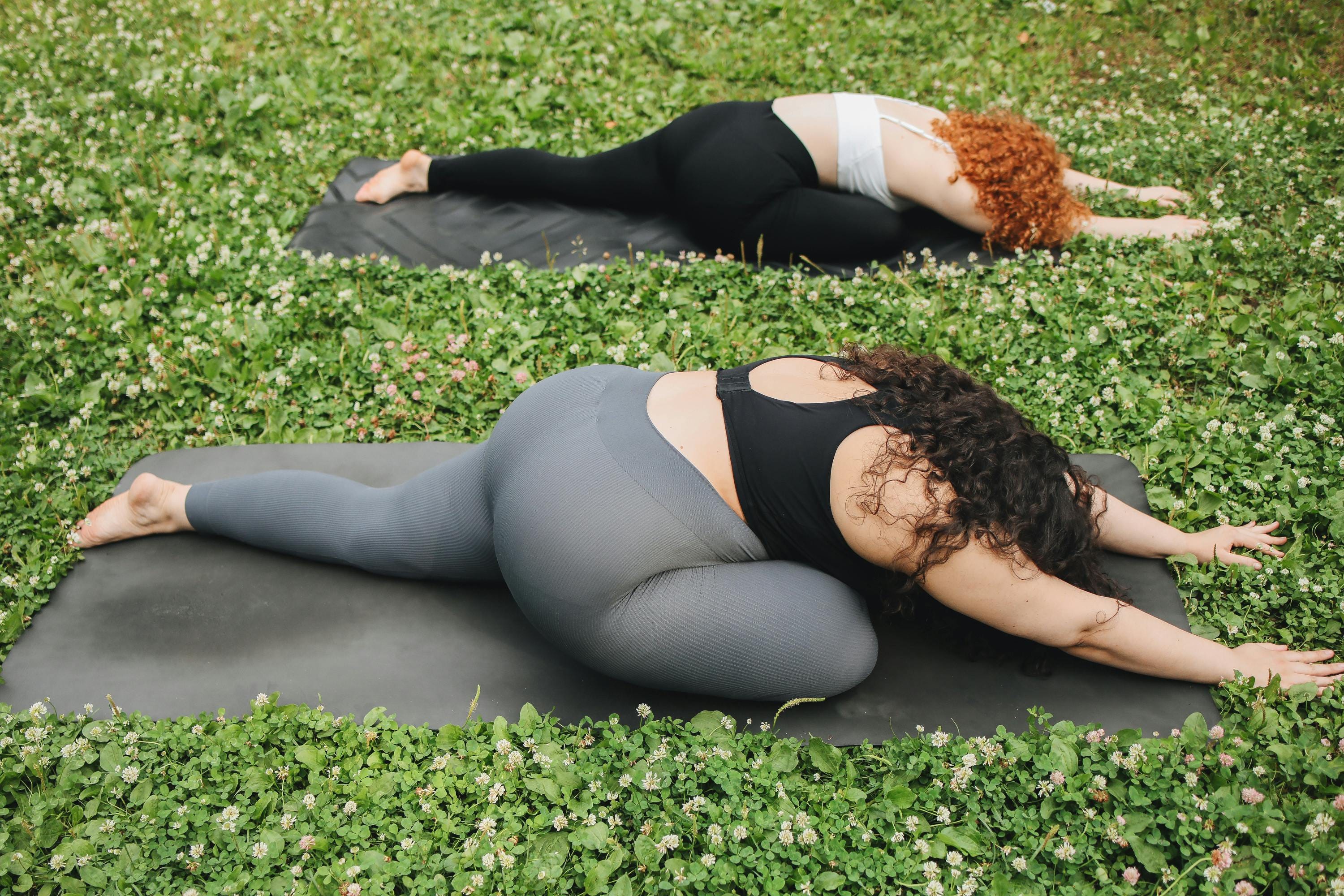
Often, it’s the smallest movements that create the most relief:
rolling your shoulders back once and realizing they were inching toward your ears
stretching your hands and noticing your fingers were curled,
unclenching your jaw and feeling how tender it is.
Intuitive movement is less “do it correctly” and more “what would feel kind right now?”
Maybe that means swaying a little while you stand. Maybe it means rocking your feet on the floor. Maybe it means a slow stretch that turns into a pause because your body is like, yes… more of that.
That’s a very different energy than pushing through.
And when your body gets to move with choice (at your pace), it starts to trust you again.
Step 3: Breath as a bridge back to presence (without making it a project)
Breathwork can be helpful… and also annoying when you’re already overwhelmed.
Because sometimes you try to take a deep breath and your body is like, lol no.
So instead of controlling your breath, it can often be more supportive to simply notice it.

Where is it landing naturally? Chest? Throat? Belly? Is it shallow? Held?
Even a tiny shift can help:
letting your exhale be a little longer than your inhale
breathing out like you’re fogging a mirror (soft and slow)
placing a hand on your chest or belly, not to force anything, just to be in contact
You don’t have to “get it right.” The goal is relationship, not performance.
Step 4: Learning to trust your body’s cues again
A lot of sensitive people are excellent at noticing everyone else… and late to notice themselves.
You might realize you’re hungry only when you’re suddenly irritated. You might push through your fatigue until your body shuts down. You might not recognize you’re overstimulated until you’re snapping at someone you love or you’re crying in the bathroom like, okay cool, apparently I’m not fine.
Reconnecting with your body’s cues is a slow rebuilding.
It can start with small questions:
Where am I holding tension right now?
Is my body asking for movement… or for stillness?
What would “one notch softer” look like in this moment?
Reflection prompt:
What’s one cue your body gives you when you’re getting overwhelmed? Tight shoulders, faster thoughts, numbness, restlessness, something else?
Step 5: Releasing without forcing it
Release doesn’t always look like a big emotional moment. Through intuitive movement, breath, and spacious pauses, we’ll explore what it feels like to let energy shift without forcing release.
Sometimes release is…
A spontaneous sigh while you’re stretching. Sometimes it’s your stomach unclenching after you finally eat. Other times, it’s tears that show up out of nowhere when your body realizes it can stop holding everything together for a minute.
You don’t need to understand every feeling for it to move through and out of you. Your body often just needs permission.
Permission to pause.
Permission to soften.
Permission to stop gripping.
This is about creating room; inside your body and inside your week.
Step 6: Letting Your Body Set the Pace
When you start rooting into your body, you may notice something almost… awkward at first: how fast you’ve been moving.
Not just physically, but internally. The quick mental jumping. The “I’ll rest after this” energy. The way you keep going even when your body is clearly tapping you on the shoulder.
Sometimes you only realize it later—when you’re finally sitting down and your jaw aches, your shoulders feel glued to your ears, or your stomach is doing that tight little twist that says, we’ve been in stress mode for a while.

For a lot of sensitive and neurodivergent folks, this pace isn’t a choice you consciously made. It’s a nervous-system habit.
Staying alert, staying ready, staying one step ahead can feel safer than slowing down. But the cost is that you end up living slightly ahead of yourself (responding, managing, holding it together) while your body quietly waits for you to come back.
Rooting is a return to your own timing.
It’s learning to pause long enough to hear the smaller signals before they turn into louder ones. The subtle tightening when you say yes too fast. The exhale that happens when you finally let yourself soften. The moment you realize you’re hungry, overstimulated, or just done for the day.
This is where Safety starts to become real. Not as something you think your way into, but as something you practice through tiny choices: a slower transition, a gentler breath, a softer “not right now.”
And rising? It doesn’t have to be a big, dramatic glow-up.
Sometimes rising looks like answering one email later. Taking a beat before you respond. Feeling your feet on the floor when your mind starts sprinting. Trusting your own pace even if it’s different from everyone else’s.
When your body gets to set the rhythm, clarity shows up more naturally, and confidence feels less like forcing, and more like coming home.
Exploring Element 7: Embodiment
So much of what we’ve been naming here gently leads back to one core truth: your body already knows.
Not in a loud or dramatic way, but in the quiet signals it offers throughout the day. The tightening, the softening, the pull toward rest, the urge to move.
Embodiment is the practice of noticing those signals and responding with care instead of overriding them.
Within the Nine Elements of Nourishment™, Element 7: Embodiment is about learning to live with your body, not just inside it.

For us sensitive and neurodivergent folks especially, embodiment can be deeply regulating. When your system is wired to pick up on everything, tuning inward helps you catch your needs earlier before overwhelm, shutdown, or burnout sets in. It allows you to meet yourself where you are, instead of where you think you should be.
Slower pacing, gentler movement, and honest check-ins aren’t indulgences here; they’re how nourishment happens.
Embodiment isn’t about doing more practices or getting it right. It’s about feeling more honestly. About letting your body guide the rhythm instead of your to-do list.
And each time you choose presence over pushing through, even briefly, you’re practicing this Element.
You’re reminding your system that it doesn’t have to shout to be heard.
Root & Rise Hour With Tori (of Transform with Tori)
If you’re often living in your head, craving a way to feel more grounded in your body without forcing calm or pushing past your limits, we’d love to have you with us.


Workshop: Root & Rise Hour With Tori (of Transform with Tori)
Date: Monday, January 5
Time: 6:30–7:45 PM
RSVP → https://luma.com/nq1vg8p6
Facilitator: Tori Carroll of Transform with Tori (https://www.transformwithtori.com/)
This Seed Starter Workshop is a gentle, guided learning space for sensitive, intuitive, and neurodivergent folks who want to reconnect with their bodies in a way that feels safe and supportive. Through nervous-system–friendly movement, breathwork, reflection, and intuitive embodiment, you’ll be invited to root into your body’s wisdom and rise into a more grounded, aligned sense of self—at your own pace.
There’s no pressure to share, perform, or have it all figured out. You’re welcome to listen quietly, move gently, reflect through journaling, or simply be present. The intention is to help you plant a small, nourishing seed you can carry with you into daily life—one that supports emotional regulation, inner steadiness, and trust in your own rhythms.
If you’ve been longing for a softer way to come home to yourself, this gathering is a beautiful place to begin. You can save your spot here when you feel ready → https://luma.com/nq1vg8p6
A Note About Access
Sensitive Sanctuary Circles, Workshops, and other TNS gatherings are open to everyone.
TNSC Members attend for free as part of membership, with full access to every gathering, invitation, and community space.
Guests are warmly welcome to join any circle for $22.
First timers are welcome to join for FREE with Coupon Code: FIRSTCIRCLEFREE
If you’d like to attend regularly and the cost isn’t accessible for you right now, or you have questions about the circle, please reach out to Leah directly at leah@nourishedsensitive.com.
If you’ve been curious about our events, or want to deepen into the sanctuary we’re building together, you’re warmly invited to upgrade your membership to receive all future invitations and to help sustain this gentle, soul-centered community sanctuary.

What is Seed Starter Workshop?
A Seed Starter Workshop is a gentle, guided learning space for sensitive, intuitive, and neurodivergent folks who want support, structure, and embodied tools—without overwhelm or pressure. These workshops help you “plant a seed” you can nurture in your daily life: a new insight, a grounding practice, a nourishing rhythm, or a shift in how you relate to yourself.


Each workshop blends education, reflection, and somatic awareness in a slow, spacious way that honors your nervous system. Think of it as learning that feels supportive, grounding, and deeply human.
What Do We Do in Workshop?
We begin with a short grounding practice, then explore the workshop theme through simple teachings, journaling prompts, and gentle embodiment. You’re invited to participate at your own pace—share, listen quietly, type in the chat, or simply be present. We close with a grounding takeaway you can carry into the week.
What to Expect
🌱 You’re welcome to join with your camera on or off. Most people keep cameras on, but it’s never required.
🌱 Speaking is optional—you can share, pass, or type in the chat. Listening quietly is just as welcome.
🌱 The circle is usually small and intimate (about 6–12 people). Everyone is invited to share, but no one is ever put on the spot.
🌱 Tears, laughter, and silence are all part of the circle. All of you is welcome here.
🌱 You’re free to move, fidget, stim, step away, or take notes if that helps you stay grounded.
🌱 We’ll begin right at 6:15pm ET and end at 7:30pm ET, so you know what to expect.
For any questions, you can reach Leah at leah@nourishedsensitive.com.